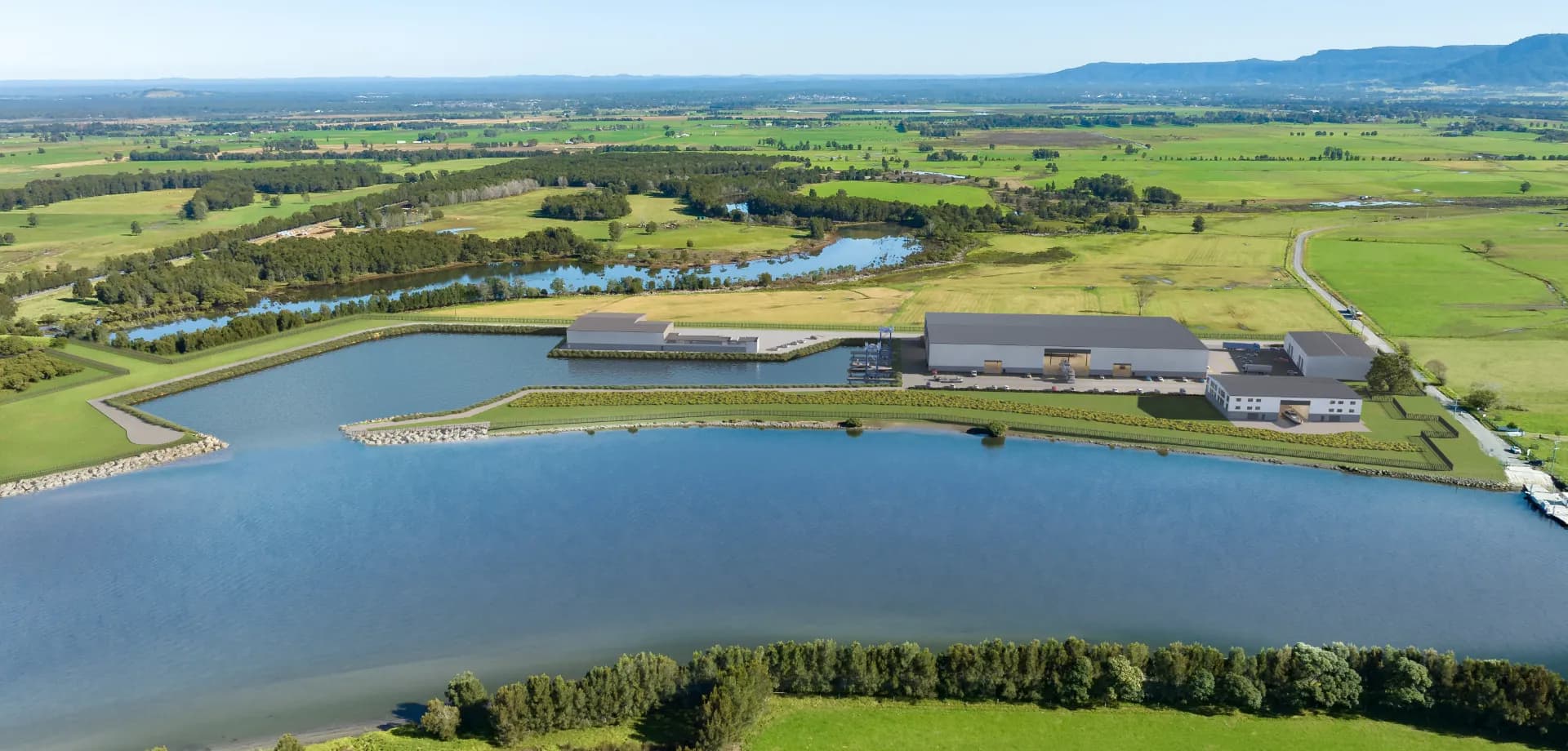
Artist impression of the East Coast Marine Centre marine facility

Investment opportunity

A scarce waterfront asset at the meeting point of demand, infrastructure and capability.

ECMC is seeking capital and strategic participation to complete an approved marine servicing precinct with more than $30 million of project groundwork already delivered.

The opportunity

Complete a facility the east coast cannot easily reproduce.

Large-vessel servicing demand is growing across the Asia-Pacific region while suitable waterfront land, deep-water access and heavy-lift infrastructure remain tightly constrained. ECMC's proposition is to complete a facility that addresses that gap from an already established physical and regulatory base \u2014 not from a greenfield start.

More than $30 million has already been invested: land acquisition, all necessary development approvals, a completed 4.5-hectare basin and access channel dredged to 10 metres LAT, initial MRO operations that commenced in 2025, and extensive site engineering. This is not a speculative project. It is an approved, partly built, already-operating facility that requires the final capital tranche to reach full commercial capacity.

The project combines freehold land and water frontage at 15 metres LAT, a completed basin and channel, development approvals for 20,000 square metres of commercial sheds and three hectares of hardstand, a plan for 1,000-tonne-plus lifting capability, and a growing customer base that has already demonstrated demand exceeds current capacity \u2014 five vessels accepted for MRO work in 2025 and three declined. That combination gives investors exposure to an operating marine business and the completion of a long-life infrastructure asset in a single transaction.

The investment thesis rests on ECMC qualifying under three distinct asset-class frameworks simultaneously \u2014 alternative assets, infrastructure and defence-aligned infrastructure \u2014 each of which is independently supported by market trends, comparable transactions and government strategic direction. An investor does not need all three to hold; any one provides a sufficient basis for the opportunity.
$30M+

Project investment to date

$32.5M

Indicative completion raise

34–41%

Project-sponsored IRR range

9 years

Modelled investment horizon

Financial figures are high-level project projections supplied by ECMC, not guarantees. They are subject to assumptions, risk, due diligence and the detailed financial model available through the Information Memorandum and virtual data room.

Three connected asset classes

One project, with several sources of long-term value.

ECMC does not fit neatly into a single investment category. It qualifies simultaneously as an alternative asset, an infrastructure asset and a defence-adjacent facility. That combination is deliberately unusual \u2014 it means the project's value is not dependent on any single market trend or sector cycle.

01

Alternative asset

Marinas and refit platforms create resilient, service-led income from waterfront assets that are scarce by nature and expensive to replicate. Institutional capital has validated the sector at scale: Blackstone acquired Safe Harbor Marinas for US$5.65 billion in 2025. Bain Capital raised a US$3.4 billion fund targeting marina and marine-infrastructure assets in January 2026. Squircle Capital acquired 100% of MB92, the world's largest superyacht refit operator, in March 2026. MA Financial added Gold Coast City Marina to its growing Australian marina portfolio in the same month. These transactions confirm that purpose-built marine servicing infrastructure is treated by the market as a serious, yield-bearing alternative-asset category — not a niche play.

02

Infrastructure

The value in ECMC sits in physical assets that cannot easily be reproduced: deep-water river frontage at 15 metres LAT with direct access to the Tasman Sea, a completed 4.5-hectare marina basin dredged to 10 metres LAT, Torrens Title freehold land, development approvals for 20,000 square metres of sheds and three hectares of hardstand, and a planned 1,000-tonne-plus lifting capability. These are hard-won, supply-constrained assets that take years — often decades — to permit and construct. The infrastructure asset class rewards exactly this kind of barrier-to-entry: long-life, location-locked facilities with growing demand and limited competing supply.

03

Defence-aligned

ECMC sits 15 nautical miles from EAXA — Australia's largest offshore naval exercise area — and adjacent to HMAS Albatross, the Royal Australian Navy's naval air station, and HMAS Creswell, its naval officer training establishment. This proximity creates direct adjacency to the AUKUS Pillar II growth vector: autonomous undersea and maritime systems. Ghost Shark, Australia's XL-AUV programme valued at approximately A$1.7 billion, and Bluebottle, a USV programme valued at approximately A$176 million, are developed and tested in the EAXA corridor. Globally, dual-use shipyards are a proven model — Damen, Fincantieri, Austal and others operate on the same principle. Defence revenue is deliberately excluded from ECMC's base valuation, meaning any Defence-related activity represents pure upside.

Market and capital validation

Institutional capital has already validated the sector.

The marine-servicing and marina-infrastructure sector has moved from a fragmented industry to an institutional-grade asset class in the space of 24 months. Four transactions between 2025 and early 2026 establish the precedent for ECMC's capital structure, operating model and eventual exit pathway.

Blackstone

US$5.65 billion

2025

Blackstone acquired Safe Harbor Marinas, the largest owner-operator of marinas in the United States, for US$5.65 billion. The transaction valued the marina sector as institutional-grade infrastructure \u2014 predictable, recurring, asset-backed income from a supply-constrained category. Safe Harbor operates over 100 marina locations. The Blackstone acquisition established a valuation benchmark for the entire sector and signalled that the largest allocators in the world see marina and refit assets as core infrastructure holdings.

Bain Capital

US$3.4 billion fund

January 2026

Bain Capital raised a dedicated US$3.4 billion fund targeting marina and marine-infrastructure investments in January 2026. The fund represents the largest pool of institutional capital ever raised specifically for the sector. Bain's thesis mirrors ECMC's: that waterfront servicing infrastructure is supply-constrained, generates resilient cash flows and benefits from long-term structural tailwinds in vessel demand and fleet growth.

Squircle Capital

100% of MB92

March 2026

Squircle Capital acquired full ownership of MB92, the world's largest superyacht refit operator, in March 2026. MB92 operates two of the most advanced superyacht refit facilities in Europe, in Barcelona and La Ciotat. The acquisition signals that private equity sees superyacht refit infrastructure as a scalable, consolidatable asset class with strong operating margins and high barriers to entry.

MA Financial

Gold Coast City Marina

March 2026

MA Financial Group added Gold Coast City Marina to its Australian marina portfolio in March 2026, following its earlier acquisition of d'Albora Marinas for approximately $225 million. The transaction demonstrates that Australian institutional capital is actively seeking exposure to marine-servicing infrastructure in the domestic market. GCCM is one of the largest superyacht-capable facilities on Australia's east coast, and its addition to the MA Financial portfolio validates the asset class in the Australian context specifically.

These comparable transactions are cited as evidence of sector maturity and institutional acceptance. They are not predictions of ECMC's outcome and should not be relied upon as guarantees of future performance. Each transaction involves different assets, geographies, market conditions and capital structures.

Why now

Four forces are converging on the same missing capability.

The investment thesis can be stated simply. Four independent, structural trends \u2014 capital, demand, infrastructure, capability \u2014 are each creating pressure on the same missing facility type. ECMC is the infrastructure response to that convergence. None of these forces is cyclical. Each represents a multi-decade shift in how maritime servicing is capitalised, demanded, constrained and enabled.

Capital

Institutional investment in marinas and refit platforms has accelerated sharply. Blackstone’s acquisition of Safe Harbor Marinas (US$5.65 billion, 2025) established the sector as institutional-grade infrastructure. Bain Capital followed with a dedicated US$3.4 billion marine-infrastructure fund in early 2026. Squircle Capital’s full acquisition of MB92 and MA Financial’s expansion into Gold Coast City Marina confirm that large, sophisticated allocators see this asset class as scalable, cash-generative and resistant to economic cycles. The same capital that has consolidated the US and European markets is now searching for equivalent opportunities in the Asia-Pacific region. ECMC is positioned to benefit from that capital rotation.

Demand

The global superyacht fleet has grown 606% over the past 40 years. As of mid-2026, 1,093 superyachts are in build or on order globally — a forward order book that sustains demand for refit, repair and maintenance services for years to come. Refit capacity is not keeping pace. The industry’s leading trade publication, IBI, reported in August 2026 that global refit capacity is falling behind fleet growth, calling it a ‘critical concern’ for owners and operators. The Asia-Pacific region is emerging as the world’s third major cruising area, with builders like Sanlorenzo expanding into Australia, Singapore and Japan. Demand exists; the infrastructure to serve it does not — and ECMC directly addresses that imbalance.

Infrastructure

Australia’s east coast has a structural shortage of large-vessel lifting and servicing capacity. The deepest, highest-capacity options for vessels over 40 metres are concentrated on a small number of facilities, many operating near full utilisation. New facilities require deep-water river or shoreline access, development approvals that routinely take 5–10 years, environmental assessments, and capital expenditure in the tens of millions before the first vessel is lifted. The combination of these requirements creates an effective barrier to new supply. ECMC has already cleared most of that barrier: approvals are in place, the basin and channel are constructed, and MRO operations are generating revenue. Completing the facility requires the next phase of capital, not a decade of regulatory process.

Capability

AUKUS Pillar II is directing substantial government and industry investment toward autonomous maritime systems, undersea warfare capabilities, electronic warfare and artificial intelligence applications in the maritime domain. These systems need test, support and sustainment infrastructure that is secure, deep-water and adjacent to naval operating areas. EAXA — Australia’s largest naval exercise area — is 15 nautical miles from ECMC’s site. Ghost Shark (XL-AUV) and Bluebottle (USV) programmes are already operating in that corridor. The Shoalhaven region has the highest ratio of tradespeople per capita in Australia and over 90 years of continuous naval operations through HMAS Albatross and HMAS Creswell. The workforce, the proximity and the dual-use model position ECMC as a natural infrastructure partner for the defence capability that is being built now.

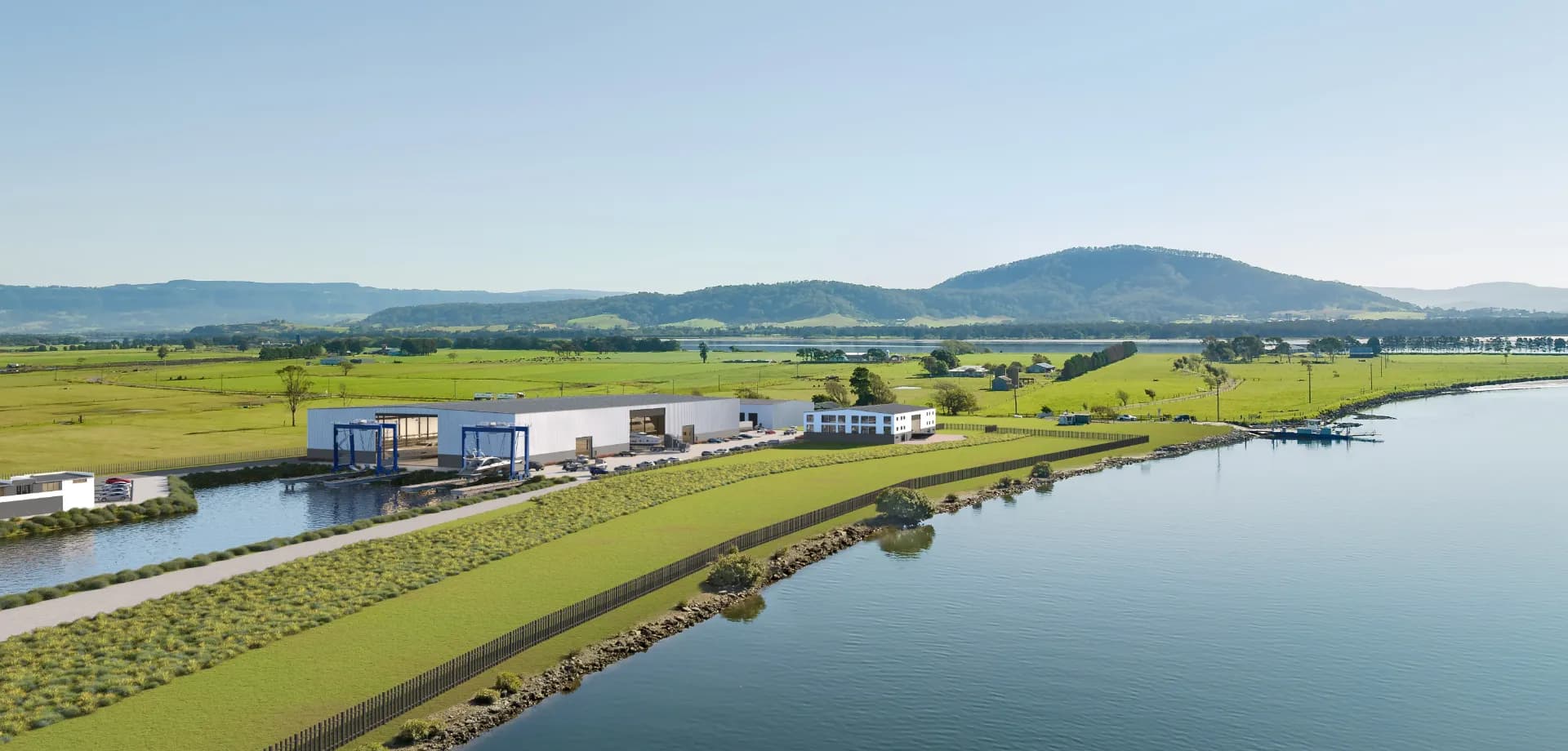
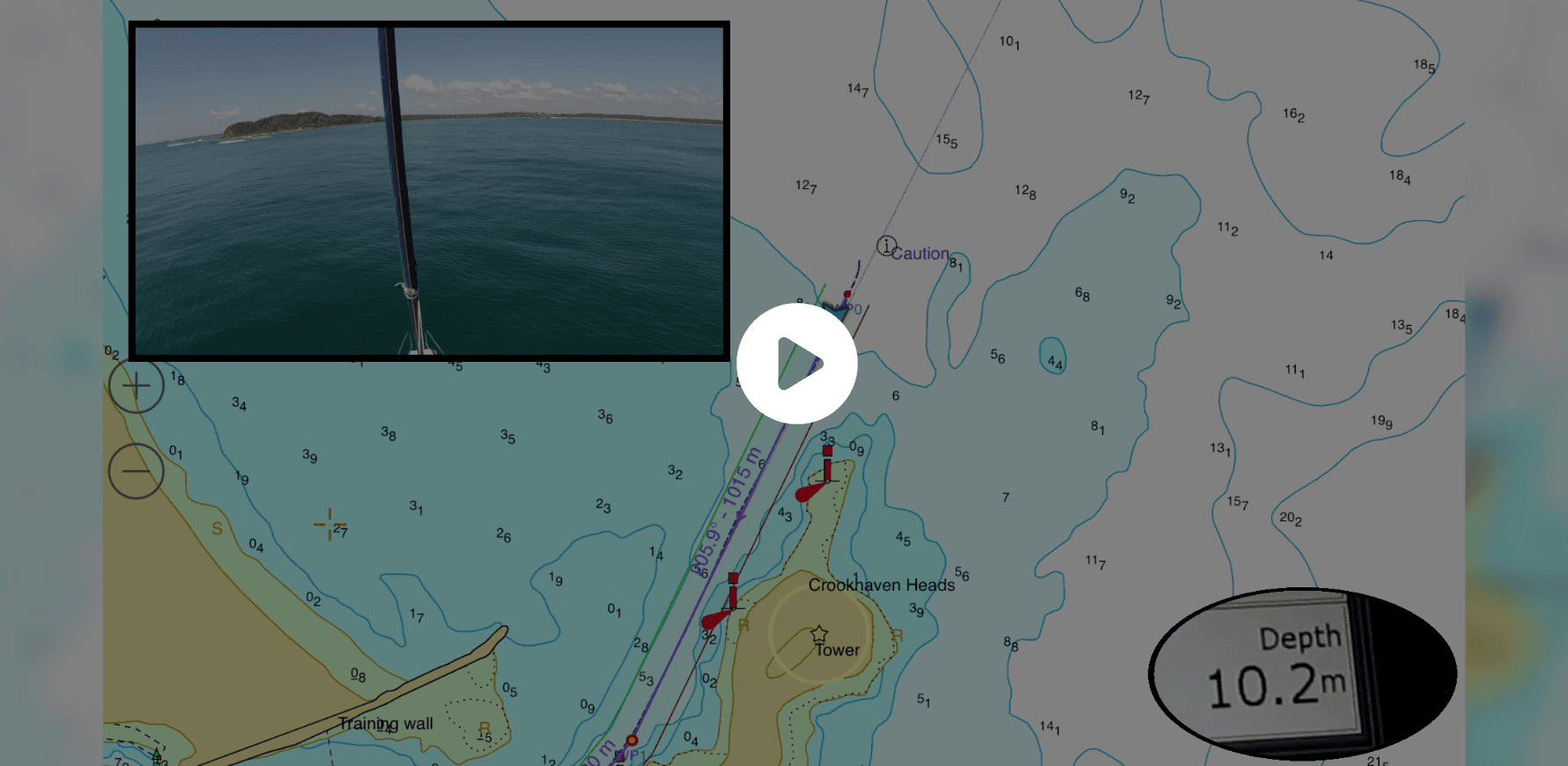
ECMC's water access and precinct context

Defence dimension

AUKUS Pillar II and autonomous systems represent the next wave of defence demand.

ECMC sits 15 nautical miles from EAXA, Australia\u2019s largest offshore naval exercise area, and directly adjacent to HMAS Albatross, the Royal Australian Navy\u2019s naval air station, and HMAS Creswell, its naval officer training establishment. This location creates what Defence planners call adjacency to operating capability \u2014 the single most important factor in locating test, support and sustainment infrastructure.

AUKUS Pillar II is directing accelerating investment toward autonomous underwater vehicles, uncrewed surface vessels, electronic warfare systems and maritime artificial intelligence. Ghost Shark, Australia\u2019s XL-AUV programme valued at approximately A$1.7 billion, and Bluebottle, a USV programme valued at approximately A$176 million, are both developed and tested in the EAXA corridor that begins 15 nautical miles from ECMC\u2019s site. These programmes need secure, deep-water shore infrastructure for launch, recovery, maintenance and data download \u2014 exactly the type of capability a completed ECMC would provide.

Dual-use maritime facilities \u2014 serving both commercial and defence customers \u2014 are a proven global model. Damen Shipyards, Fincantieri, Austal and others operate facilities where commercial refit capacity coexists with defence sustainment work. ECMC is designed on the same principle. Because Defence revenue has been deliberately excluded from ECMC\u2019s base financial model, any Defence-related activity that emerges represents incremental upside beyond the base investment case.

The asset

Site specifications that define the capability.

The physical asset is already substantially in place. What follows is the site as it exists today.

4.5 ha

Marina basin at 10 metres LAT

1,000 LM

Water frontage at 15 metres LAT

20,000 m²

Approved commercial sheds

3 ha

Approved hardstand area

Basin and channel

4.5-hectare marina basin dredged to 10 metres LAT, accessed via a 5-metre LAT approach channel. The basin is fully constructed and operational, capable of accommodating vessels up to 50 metres at the present wharf infrastructure. A 50-metre-wide entrance provides safe two-way access in all tidal conditions. Additional depth for larger vessels is available at the deep-water frontage along the 1,000 linear metres of river frontage at 15 metres LAT, suitable for alongside servicing without dredging.

Land and approvals

Torrens Title freehold land with direct river frontage on the Shoalhaven River. All key development approvals are in place: four commercial shed buildings totalling 20,000 square metres, three hectares of hardstand for vessel storage and staging, and an additional 2.5-hectare site reserved for future expansion. The approvals process spanned multiple levels of government and included environmental assessments, community consultation and infrastructure agreements \u2014 a regulatory pathway that would take 5\u201310 years to replicate.

Operations and capability

Maintenance, repair and overhaul operations commenced in 2025. In the first operating period, five vessels were accepted for MRO work and three were declined due to capacity constraints \u2014 demand already exceeds current capability. The planned 1,000-tonne-plus lifting system will unlock the full commercial capacity of the facility, enabling vessel lifts that are currently unavailable on the east coast. The facility is designed to serve vessels in the 30-to-100-metre range across superyacht, commercial and defence segments.

Utilities and workforce

The site has existing power reticulation, water supply, wastewater treatment capacity and telecommunications connectivity. The Shoalhaven region benefits from the highest ratio of tradespeople per capita in Australia and over 90 years of continuous naval operations. The site layout accommodates future integration of shore power for vessels and potential on-site renewable generation.

ECMC approved development plan

Use of capital

Capital completes construction and equips the operating platform.

The $32.5 million indicative completion raise is divided between two primary allocations, with the detailed breakdown available through the Information Memorandum.

67%

Construction, trade buildings, hardstand and associated site works \u2014 including site preparation, earthworks, four commercial sheds totalling 20,000 square metres, 3 hectares of paved hardstand, and all utilities and site services.

33%

Marine equipment, including the planned 1,000-tonne-plus marine straddle carrier, yard handling equipment, quayside mooring infrastructure, and all commissioning and integration work.

Financial summary

An investment case with multiple realisation pathways.

The financial model is built around a nine-year investment horizon with a projected project-sponsored IRR of 34\u201341% and approximately $110 million in projected profit share. These figures are based on the detailed financial model, assumptions and projections contained in the Information Memorandum. Summary metrics only are presented here; the full model is available through the virtual data room to qualified investors.

$30M+

Investment to date

$32.5M

Completion raise

34–41%

Project-sponsored IRR

~$110M

Projected profit share

Institutional sale

Sale to an infrastructure or alternative-asset fund at stabilised yield, consistent with the Blackstone Safe Harbor and MA Financial GCCM transaction model. This is the most likely exit pathway given the comparable transactions in the sector.

Strategic acquisition

Acquisition by a superyacht builder, refit operator or Defence prime seeking vertically integrated infrastructure. The scarcity value of an approved, operating deep-water facility supports this pathway.

Recapitalisation

Refinancing or recapitalisation at stabilised yield, returning initial capital while retaining ongoing participation in the cash flows of the operating asset. Available as early as Year 5 subject to market conditions and asset performance.

Founder continuity

The project knowledge stays with the asset.

The single most important critical success factor in taking an asset from development to operating asset is founder involvement. When the founder leaves during the construction or ramp-up phase, investments disproportionately fail or underperform. ECMC is structured around the opposite model.

The founder is not seeking an immediate exit. The intended model keeps founder involvement through construction, commissioning and operational ramp-up, preserving the approvals knowledge, relationships and practical decisions built over the project\u2019s development. This continuity protects the asset\u2019s value during the period when most value is at risk. Alternative succession arrangements \u2014 including a founder exit at stabilisation \u2014 can be considered once the facility is fully operational and cash-generative.

Strategic equity

Participation by investors with relevant marine, engineering, lifting or infrastructure experience who recognise ECMC as a synergistic fit with existing holdings. Family offices with adjacent industrial or maritime assets gain exposure to a scalable operating platform in a supply-constrained asset class.

Operating partnership

Collaboration with established refit, marina or marine-services operators who bring operational expertise, customer relationships and brand credibility to the facility. The model mirrors the institutional approach of platforms like Safe Harbor and MB92, where local operators partner with capital partners.

Equipment partnership

Preferred supply, training and lifecycle support arrangements for the heavy-lift system and yard equipment. Equipment partners gain a flagship reference installation in a growing Asia-Pacific servicing hub, supported by a long-term maintenance and spares relationship.

Technology collaboration

Co-location and demonstration opportunities for advanced maritime systems: autonomous vessels, electric and hybrid propulsion, digital twin and remote monitoring platforms, and dual-use defence technologies. ECMC offers a controlled, deep-water environment adjacent to a major naval operating area.

Detailed materials

Request the Information Memorandum.

Qualified parties can request the detailed project, financial and due-diligence materials. The Information Memorandum contains the full financial model, risk analysis, market research, development timeline and legal structure. A virtual data room with supporting documentation is available following initial qualification.

Contact Simone Coombes